Amplification and Speakers
The last two links in the chain are the amplifier and the loudspeaker, and they work as a pair: the amp raises the signal to the power a speaker needs, and the speaker turns that power back into sound. Systems come in two flavours. Passive systems keep the two apart, with separate amplifier racks feeding the cabinets, while active or powered systems build the amp and processing right into the box, matched at the factory so you do not have to.
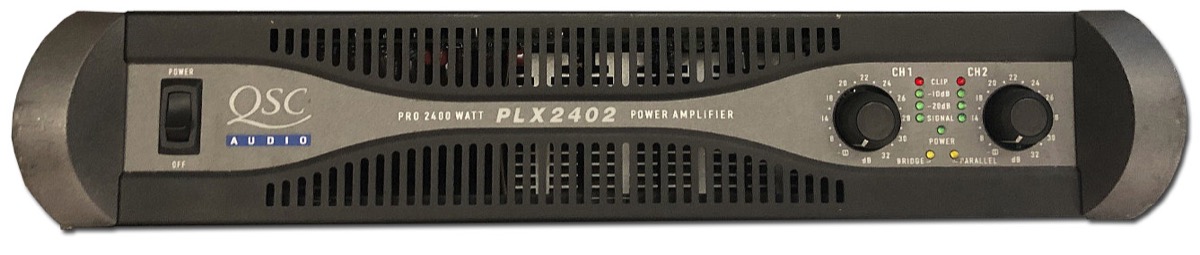
Two numbers govern how well an amp and speaker get along. The first is impedance, the speaker's electrical load, usually 8 ohms and sometimes 4 or 16. This one has a habit of biting people: wire two 8-ohm boxes in parallel and the combined load drops to 4 ohms, which roughly doubles the current the amplifier has to deliver, so the amp must actually be rated to drive that load. The second number is sensitivity, given as the SPL a box produces from one watt measured at one metre. Because every +3 dB is a doubling of power, a 96 dB cabinet needs only half the power of a 93 dB one to reach the same level — so sensitivity quietly determines how much amplifier you really need.
Headroom is the part people get backwards. A generously sized, clean amplifier — roughly twice the speaker's continuous rating — protects the speaker, because it can handle peaks without clipping. An undersized amp driven into clipping is the real danger: clipping sends distorted, DC-heavy energy into the box, and that is what cooks tweeters fast. The loud, clean signal is rarely the killer; the strained, clipped one is.
Bad amplification destroys speakers faster than loud signals.