Connectors and Signal Integrity
The connector at the end of a cable quietly decides two things: what kind of signal travels through it, and how well that signal survives the journey. Getting it right is less about what physically fits and more about matching the connection to the job.
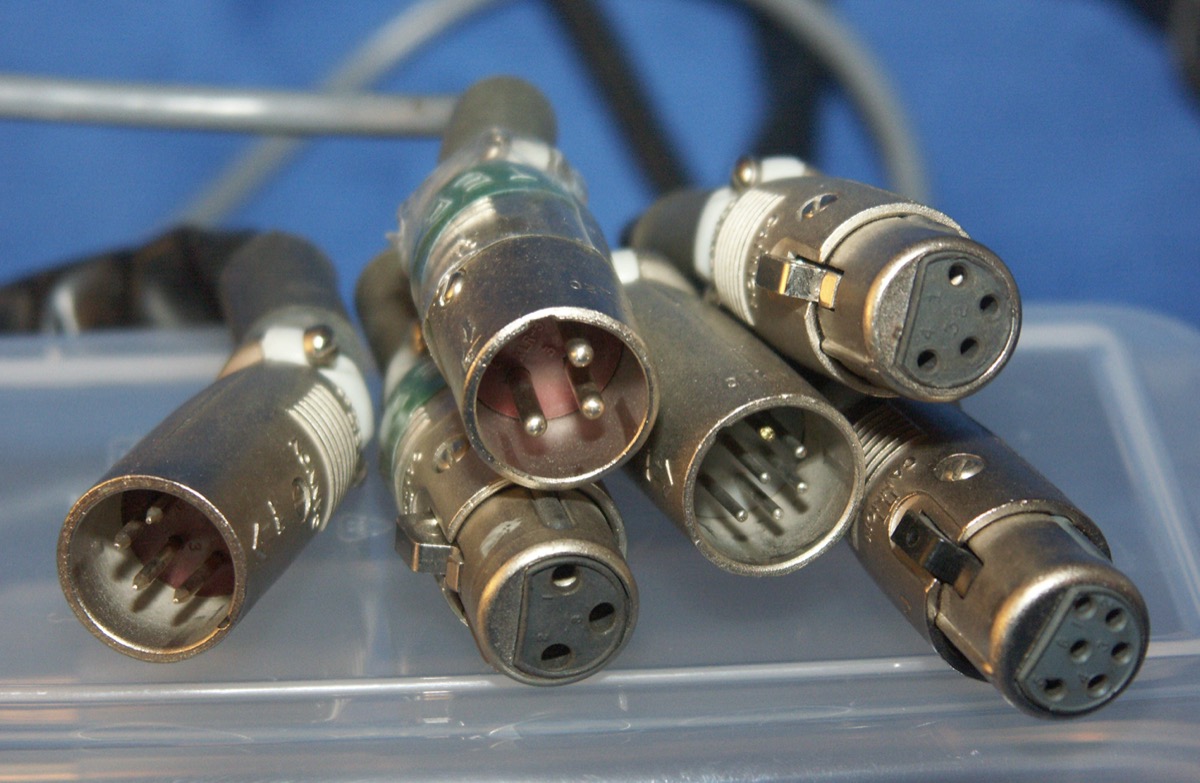
The big idea is the balanced connection. A balanced line carries three conductors — ground, hot (pin 2 on an XLR, following the AES14 standard), and cold (pin 3) — and it sends the audio as two mirror-image copies, one inverted. At the far end the receiver flips one back and adds them together. Any noise the cable picked up along the way landed on both wires equally, so when they are combined that noise cancels itself out. This trick, called common-mode rejection, is what lets a balanced line run tens of metres past dimmers and motors without humming. XLR is the standard for balanced mic and line audio; a TRS jack can carry a balanced mono signal or an unbalanced stereo one depending on how it is wired; and TS is always unbalanced, which is why those cables should stay short.
Condenser mics need power to work, and it rides up the same balanced cable as phantom power — +48 V (with 12 V and 24 V variants) defined in IEC 61938. It is harmless to dynamic mics, but it can damage a vintage ribbon if a cable is mis-wired, so it is worth a moment's care before patching one.
Speaker connections are a different world. They carry amps of current rather than millivolts of signal, and they use locking Speakon connectors precisely because the stakes are higher. They are never interchangeable with line connectors — feeding an amplifier's output into a line input can destroy it. And underneath all of this, shielding is what keeps electromagnetic interference out of the signal in the first place. A cheap, poorly shielded cable adds noise the console can never remove, so the cable is part of the signal chain, not an afterthought.
Use the right connector for the signal type — not what fits physically.