Camera Operation
Live camera work is really the disciplined control of three things: exposure, focus, and framing. Exposure itself is a balance of three settings, often called the exposure triangle. Aperture, or iris, controls how much light enters and also how shallow the depth of field is. Shutter controls how much motion blur each frame captures. And ISO, or gain, controls the sensor's sensitivity at the cost of adding noise. The one asymmetry that shapes how you expose is that blown highlights — pure clipped white — contain no information and cannot be recovered, whereas shadows can be lifted a little in post. So the working habit is to expose to protect the highlights.
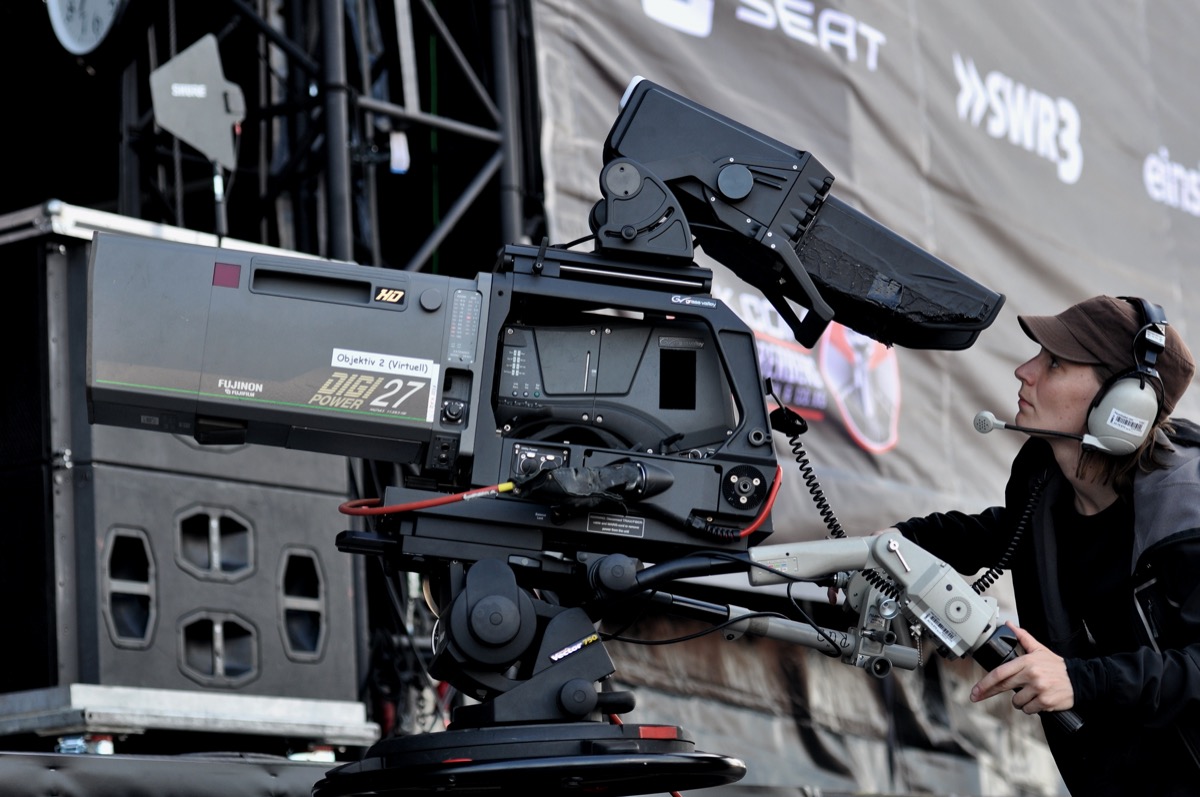
Shutter has a convention worth knowing, the 180-degree rule: set it to roughly double the frame rate — 1/50 second at 25 fps, 1/60 at 30 fps — for natural-looking motion blur. Faster shutter speeds make motion look stuttery, and they also change how the camera sees flickering LED and discharge lighting, which is why shutter is part of anti-flicker setup and not just an exposure control.
Focus has to hold on subjects that move, and framing has to stay consistent from shot to shot so the production cuts together cleanly. Across all of it, live production runs on manual control rather than the camera's automatic systems. Auto-iris hunts up and down as the scene changes, autofocus drifts onto the wrong subject at the worst moment, and auto white balance shifts the colour mid-show. You lock those settings deliberately and ride them by hand, because predictability matters more than convenience when it is going out live.
Protect highlights — blown image is unrecoverable.