Fiber Optics
Fiber carries data as pulses of light rather than as electrical signals on copper, and that single difference buys two things copper cannot offer. It is completely immune to electromagnetic interference, and it reaches far beyond Ethernet's roughly 100-metre copper limit. Run a signal past dimmers, motors, and long awkward cable paths, and fiber simply does not pick up the hum and noise that would plague a copper run over the same route.
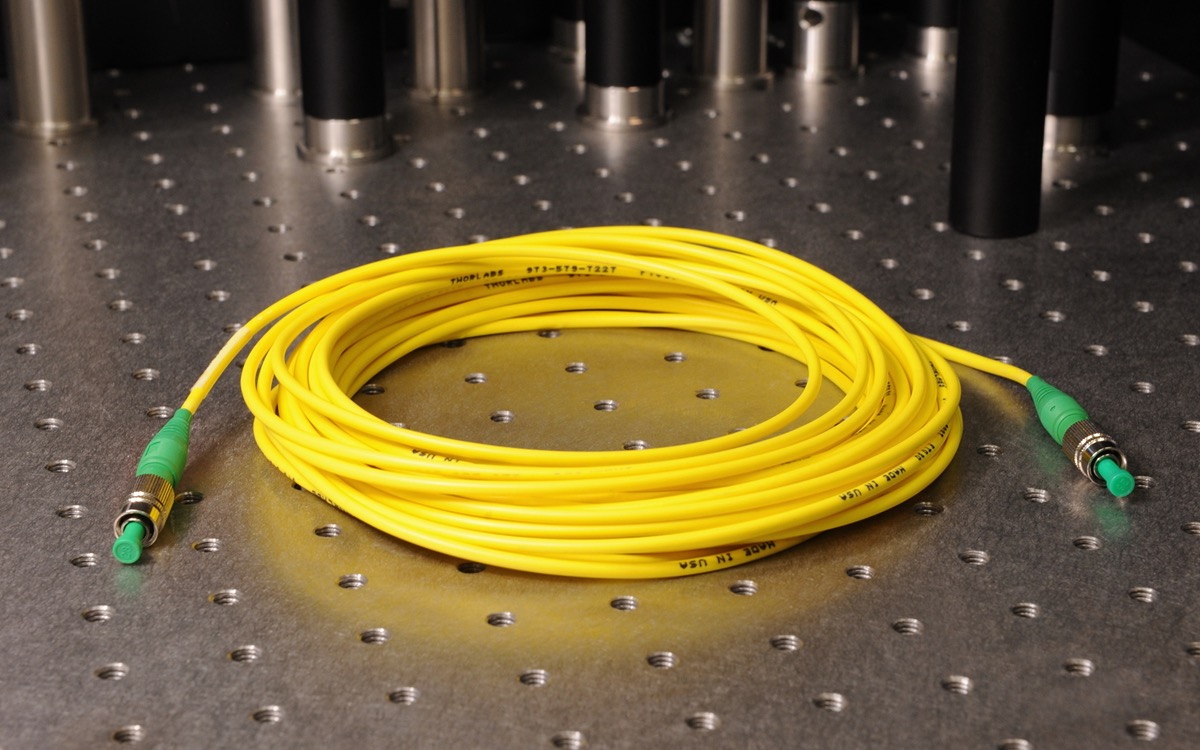
The key choice is between singlemode and multimode fiber. Singlemode has a tiny core, uses laser sources at 1310 or 1550 nanometres, and reaches kilometres — the natural choice for long runs between buildings or across a stadium. Multimode has a larger core, uses cheaper 850-nanometre sources, and comes in grades: OM3 and OM4 typically reach a few hundred metres at 10 gigabit, which is plenty inside a venue and less expensive to terminate. You pick the type to suit the distance and data rate, and the two are not interchangeable — a singlemode transceiver will not communicate with a multimode one.
The connectors, commonly LC, and the small pluggable transceivers that convert light back to an electrical signal — SFP and SFP+ — have to match the fiber type as well. For any large-scale or genuinely long-distance system, fiber stops being a luxury and becomes the only thing that actually works, which is why long distance and fiber go hand in hand.
On the connector side, LC dominates in the rack — it is the small form factor used by SFPs and switches — while touring leans on ruggedized connectors such as Neutrik's opticalCON, and broadcast cameras on the SMPTE hybrid, whose 304M connector carries two singlemode fibers and camera power in one cable. One detail is unforgiving: the polish. An APC connector (green body, ferrule angled at 8 degrees) must never be mated with a UPC one (blue body), and the trap is that the two plug together quite happily — the angle then leaves an air gap, a strong reflection, and a real risk of damaging the ferrule. And the most common fiber failure in the field is neither a break nor distance, but a contaminated end face: inspect and clean every ferrule before you connect it.
Long distance means fiber — not copper.